Why Does Corn Beef Have a Rainbow Color to It
Food Explainer: Why Is Some Deli Meat Iridescent?
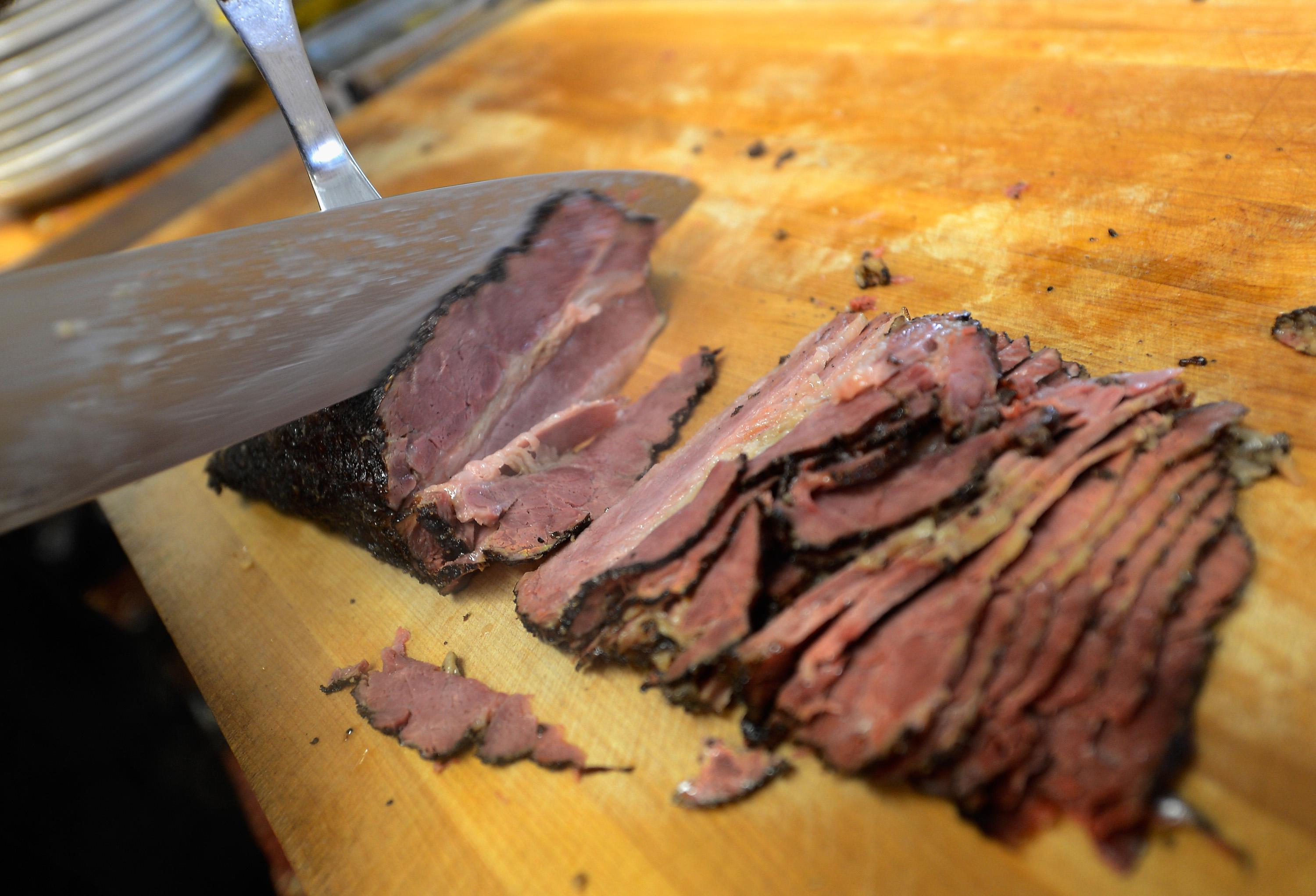
Photo past Kevork Djansezian/Getty Images
A reader (who is clearly not alone) asks: What causes some sliced cafeteria meats to possess an iridescent sheen? On occasion, a slice of ham or beef will exhibit the sort of rainbow spot one might run into on an oil slick or the inside of a seashell. Why?
It's because of the particular way light bounces off the surface of the cafeteria meat, a phenomenon known every bit "diffraction." A slice of meat is composed of strands of fibers that are tightly packed together in parallel bundles. Afterwards meat is sliced, the cut ends of the fibers class a series of grooves, like the meridian of a picket fence. White light is composed of a spectrum of different colors, and each one of those colors has a specific wavelength. When white low-cal hits the grooves on the surface of a cafeteria meat slice, some of the low-cal is absorbed and some of it is reflected. Each component color wave of the reflected low-cal bends at a different angle depending on its detail frequency. The result of this spread of color waves is a kaleidoscope or iridescent effect, like to the colors we run into in soap bubbling, CDs, and fish scales.
Diffraction depends on the grooves being structurally intact and perfectly aligned. This is why you're much more likely to meet this rainbow upshot on processed deli meat that'southward cooked and/or cured than on raw meat. The old has a firmer, tougher texture and the picket fence construction keeps its shape well when deli meats are sliced. Raw meat, on the other hand, is softer and more delicate, and the ends of the meat fibers are hands damaged when the meat is cutting, which means that light is reflected in a haphazard way that doesn't result in rainbows.
So why do some deli meats shimmer while others remain wearisome? The color of the meat matters. Dark cooked meat like roast beef and bright cured meat similar ham are more than likely to evidence iridescence considering the groundwork colors provide a starker dissimilarity to the pearly greens and orangey reds that you're most probable to see coming off of shiny meats. Turkey and chicken are too stake to showcase such sparkle. Information technology also matters whether the deli production contains basis or "restructured" meat (in which chopped meat is molded together) or is comprised of a single slice of muscle. In the former instance, the jumbled up meat fibers are no longer aligned correctly to diffract light.
The way a joint of meat is sliced at the deli counter or before being pre-packaged is as well paramount. Only cuts that are sliced confronting the grain, or perpendicular to the direction of the meat fibers, prove iridescence, since the protruding severed ends of the fibers produce the fine grooves. (For beef, these cuts are brisket, which is used for corned beef; navel, used for pastrami; and elevation round, used for roast beef.*) The sharpness of the blade with which the meat is sliced makes a departure, likewise. The sharper the slicing musical instrument, the cleaner the cut, the smoother the surface, and the more intense the brandish of rainbow hues. Blunt knives produce rough surfaces; the picket debate grooves volition exist too disrupted to produce iridescence.
The commercial curing process can cause sliced cafeteria meats to have an especially smooth surface, which is why y'all sometimes encounter dazzling rainbows on cured hams. Cured meats are first injected with a alkali or marinade and and then tumbled in revolving metal drums to allow the brine to penetrate evenly throughout the meat. This process causes proteins to seep out from cells and fill up gaps between muscle fibers, creating an fifty-fifty, consistent texture that'southward more likely to diffract light when sliced.
Fatty content too has an impact on the lite-reflecting properties of meat: A particularly fatty cut of meat is unlikely to diffract low-cal. A slice of roast beef that'south richly and evenly marbled with fat won't shine. Fat is either liquid (at room temperature) or semi-crystalline (when chilled), and neither of these states possess the right grooved construction to create a rainbow sheen.
Since diffraction is a purely concrete phenomenon and has nix to practice with microbial growth, iridescent deli meat poses absolutely no safety gamble, nor does it have whatever effect on taste. Simply this might not ever be the case with raw meat, which can occasionally exhibit iridescence. Raw meats are more prone to bacterial contagion, and a colorful glow could be caused by lite reflecting off a surface movie of liquid produced past microbes. To decide whether your irised raw meat is dangerous, lightly wipe the surface of the meat with a paper towel. If the sheen disappears, and then the meat is likely harboring slime-producing microbes, and you should discard it.
Nutrient Explainer thanks Edward Mills of Penn State and Andrew Milkowski of the University of Wisconsin-Madison.
Have a question about something yous're eating or drinking? Send information technology to slatefoodexplainer@gmail.com .
Correction, Sept. x, 2013: Because of an editing fault, this postal service misstated that pinnacle round is used for pastrami and that navel is used for roast beef. It'south the other mode effectually. (Return to the corrected sentence.)
Previously from the Nutrient Explainer:
Why Does Food Gustation Better When Information technology's Browned?
Why Does Microwaving Water Upshot in Such Lousy Tea?
What's the Difference Between Yogurt and "Cultured Dairy Blend"?
Why Does Tomato plant Sauce Splatter When Information technology Cooks?
Why Does Steam Make Bread Light and Crusty?
Why Does Eating Hot Chilies Make My Nose Run?
Why Are Some Boiled Eggs Easier To Skin Than Others?
Why Does Fish Sauce Have an Expiration Engagement?
Why Is Cheese Yellow When Milk Is White?
Source: https://slate.com/culture/2013/09/iridescent-deli-meat-why-some-sliced-ham-and-beef-shine-with-rainbow-colors.html
0 Response to "Why Does Corn Beef Have a Rainbow Color to It"
Post a Comment