what method did dr. robert ballard use to find the wreck of the titanic
| Robert Ballard | |
|---|---|
 | |
| Built-in | Robert Duane Ballard (1942-06-30) June thirty, 1942 Wichita, Kansas, U.S. |
| Education | Academy of California, Santa Barbara; Academy of Hawaii, Manoa; Academy of Southern California |
| Employer | University of Rhode Island Graduate School of Oceanography |
| Known for | Bounding main exploration and underwater archæology; discoveries of the wrecks of the RMS Titanic, the battleship Bismarck, the aircraft carrier USS Yorktown, and John F. Kennedy's PT-109 |
| Awards | Kilby International Awards (1994) The Explorer Medal (1995) Hubbard Medal (1996) Caird Medal (2002) |
| Military machine career | |
| Allegiance | United States |
| Service/ |
|
| Years of service | 1965–1995 |
| Rank |  Commander Commander |
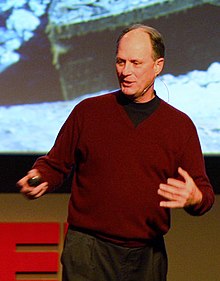
Robert Duane Ballard (built-in June 30, 1942) is an American retired Navy officer and a professor of oceanography at the University of Rhode Island who is about noted for his piece of work in underwater archaeology: maritime archaeology and archaeology of shipwrecks. He is most known for the discoveries of the wrecks of the RMS Titanic in 1985, the battleship Bismarck in 1989, and the shipping carrier USSYorktown in 1998. He discovered the wreck of John F. Kennedy'south PT-109 in 2002 and visited Biuku Gasa and Eroni Kumana, who saved its crew. He leads ocean exploration on East/V Nautilus.[one] Ballard considers his most of import discovery to be that of hydrothermal vents.[two]
Early on life
Robert Ballard grew up in Pacific Beach, San Diego, California to a mother of High german heritage and a father of British heritage.[three] He has attributed his early interest in underwater exploration to watching (Ballard is dyslexic) [iv] the Disney adaptation of Jules Verne'due south 1870 novel Twenty 1000 Leagues Under the Sea,[v] living past the sea in San Diego, and his fascination with the groundbreaking expeditions of the bathyscaphe Trieste.[ citation needed ]
Ballard began working for Andreas Rechnitzer's Ocean Systems Group at Northward American Aviation in 1962 when his male parent, Chet, the master engineer at Due north American Aviation's Minuteman missile program, helped him go a part-time job. At North American, he worked on North American'due south failed proposal to build the submersible Alvin for the Woods Hole Oceanographic Establishment.[ citation needed ]
In 1965, Ballard graduated from the Academy of California, Santa Barbara, earning undergraduate degrees in chemical science and geology. While a student in Santa Barbara, California, he joined Sigma Alpha Epsilon fraternity, and likewise completed the U.s.a. Army's ROTC program, giving him an Army officer'south commission in Ground forces Intelligence. His start graduate degree (MS, 1966) was in geophysics from the University of Hawaii'southward Institute of Geophysics where he trained porpoises and whales. Subsequently, he returned to Andreas Rechnitzer'south Bounding main Systems Group at N American Aviation.[ citation needed ]
Ballard was working towards a PhD in marine geology at the University of Southern California in 1967 when he was called to active duty. Upon his request, he was transferred from the Army into the Usa Navy as an oceanographer. The Navy assigned him every bit a liaison between the Office of Naval Enquiry and the Woods Hole Oceanographic Institution in Forest Hole, Massachusetts.[ commendation needed ]
Later leaving active duty and entering into the Naval Reserve in 1970, Ballard continued working at Woods Hole persuading organizations and people, generally scientists, to fund and use Alvin for undersea inquiry. Iv years later he received a PhD in marine geology and geophysics at the University of Rhode Isle.[ commendation needed ]
Military machine career
Ballard joined the U.s. Army in 1965 through the Army's Reserve Officers Preparation plan. He was designated as an intelligence officeholder and initially received a committee as a 2d lieutenant in the Ground forces Reserve. When called to agile duty in 1967, he asked to fulfill his obligation in the U.s. Navy. His request was canonical, and he was transferred to the Navy Reserve on the reserve agile duty listing. Afterward completing his active duty obligation in 1970, he was returned to reserve status, where he remained for much of his war machine career, beingness called upwards only for mandatory grooming and special assignments. He retired from the Navy as a commander in 1995 after reaching the statutory service limit.[ citation needed ]
Marine geology
Ballard'south start swoop in a submersible was in the Ben Franklin (PX-15) in 1969 off the coast of Florida during a Woods Hole Oceanographic Institution expedition. In summer 1970, he began a field mapping project of the Gulf of Maine for his doctoral dissertation. It used an air gun that sent sound waves underwater to determine the underlying structure of the body of water floor and the submersible Alvin, which was used to find and recover a sample from the bedrock.[ citation needed ]
Ballard was geologist diver in Alvin during Projection FAMOUS, which explored the median rift valley of the Mid-Atlantic Ridge in 1974.[6]
During the summer of 1975, Ballard participated in a joint French-American expedition called Phere searching for hydrothermal vents over the Mid-Atlantic Ridge, just the expedition did not observe any active vents.[ citation needed ]
On the Galapagos spreading center east of the islands a 1977 exploration past Alvin found deep-ocean hydrothermal vents and surrounding biology communities based on chemosynthesis. Ballard was a participating diver.[7]
The 1979 RISE project expedition on the E Pacific Ascent westward of Mexico at 21°N was aided by deep-towed still camera sleds that were able to take pictures of the body of water floor, making it easier to find hydrothermal vent locations. When Alvin inspected one of the sites the deep-tow located, the scientists observed black "smoke" billowing out of the vents, something not observed at the Galápagos Rift.[7] [viii] Ballard and geophysicist Jean Francheteau went downwards in Alvin the 24-hour interval after the blackness smokers were first observed. They were able to have an accurate temperature reading of the active vent (the previous dive's thermometer had melted), and recorded 350 °C (662 °F).[8] They continued searching for more than vents along the Eastward Pacific Ascent betwixt 1980 and 1982.[ commendation needed ]
Marine archæology
While Ballard had been interested in the sea since an early age, his piece of work at Woods Hole and his scuba diving experiences off Massachusetts spurred his interest in shipwrecks and their exploration. His work in the Navy had involved profitable in the development of small, unmanned submersibles that could be tethered to and controlled from a surface ship, and were outfitted with lighting, cameras, and manipulator artillery. As early as 1973, he saw this as way of searching for the wreck of the Titanic. In 1977, he led his start expedition, which was unsuccessful.[ citation needed ]
RMS Titanic
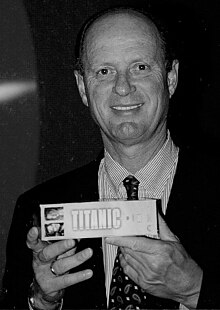
In summertime 1985, Ballard was aboard the French research send Le Suroît, which was using the side scan sonar SAR to search for the Titanic 'due south wreck. When the French ship was recalled, he transferred onto a ship from Woods Hole, the R/V Knorr. Unbeknownst to some, this trip was financed by the U.S. Navy for secret reconnaissance of the wreckage of ii Navy nuclear powered attack submarines, the USS Scorpion and the USS Thresher, which sank in the 1960s, and not for the Titanic.[ix] Dorsum in 1982, he approached the Navy about his new deep sea underwater robot craft, the Argo, and his search for the Titanic.[10] The Navy was non interested in financing it. All the same, they were interested in finding out what happened to their missing submarines and ultimately concluded that Argo was their best chance to do and then.[10] The Navy agreed it would finance his Titanic search just if he first searched for and investigated the two sunken submarines,[10] and found out the country of their nuclear reactors later being submerged for such a long time,[10] and whether their radioactivity was impacting the surround.[10] He was placed on temporary active duty in the Navy, in accuse of finding and investigating the wrecks. Afterward the two missions were completed, time and funding permitting, he was free to utilize resources to chase for the Titanic.[x]
After their missions for the Navy, Knorr arrived on site on Baronial 22, 1985,[11] and deployed Argo. When they searched for the two submarines, Ballard and his squad discovered that they had imploded from the immense pressure at depth.[12] It littered thousands of pieces of debris all over the ocean floor.[12] Following the large trail of debris led them direct to both[12] and made it significantly easier for them to locate them than if they were to search for the hulls straight.[12] He already knew that the Titanic imploded from pressure also, much the same way the 2 submarines did, and concluded that it too must have also left a scattered debris trail.[12] Using that lesson, they had Argo sweep dorsum and forth across the ocean floor looking for the Titanic's droppings trail.[eleven] They took shifts monitoring the video feed from Argo as information technology searched the ocean flooring ii miles below.[ commendation needed ]
In the early forenoon hours of September 1, 1985, observers noted anomalies on the otherwise smoothen sea floor. At offset, it was pockmarks, like small craters from impacts. Eventually, droppings was sighted every bit the rest of the team was awakened. Finally, a boiler was sighted, and before long later on that, the hull was institute.[ commendation needed ]
Ballard'due south team fabricated a general search of the Titanic's outside, noting its condition. Most significantly, they confirmed that it had separate in two, and that the stern was in far worse shape than the bow. They did not take much time to explore, equally others were waiting to take Knorr on other scientific pursuits, merely his fame was at present assured. He originally planned to keep the exact location a secret to prevent anyone from claiming prizes from it. He considered the site a cemetery, and refused to desecrate information technology by removing artifacts.[ citation needed ]
On July 12, 1986, Ballard and his squad returned on lath Atlantis II [xi] to brand the first detailed study of the wreck. This time, he brought Alvin. It was accompanied by Jason Junior, a minor remotely operated vehicle that could fit through small openings to come across into the ship's interior. Although the get-go swoop (taking over two hours) encountered technical issues, subsequent ones were far more than successful, and produced a detailed photographic record of the wreck's condition.[ citation needed ]
In 1988, Ballard published a book, Discovery Of The Titanic: Exploring The Greatest Of All Lost Ships, ISBN 0446513857 and he later on recounted the specifics of the trek for National Geographic in a video.[xiii]
The vast majority of the relics retrieved by diverse groups, not including Ballard, from RMS Titanic were owned past Premier Exhibitions which filed for bankruptcy in 2016. In late August 2018, the groups vying for buying of the 5,500 relics included one by museums in England and Northern Ireland with assistance from film maker James Cameron and some fiscal support from National Geographic.[fourteen] Ballard told the news media that he favored this bid since information technology would ensure that the memorabilia would be permanently displayed in Belfast and in Greenwich. A decision as to the outcome was to be made by a United States district court judge.[fifteen]
Other wrecks
Bismarck
Ballard undertook an even more daunting job when he and his team searched off the declension of France for the German Battleship Bismarck in 1989, using an ocean-crawling robot. The 15,000 foot deep water in which it sank[16] is four,000 feet deeper than that where the Titanic sank. He attempted to make up one's mind whether it had been sunk past the British or was scuttled past its own crew. Three weeks after the expedition yet, personal tragedy struck him when his 21-year-old son, Todd, who had aided him in the search, was killed in a car accident.[17]
Ballard later published a book well-nigh the quest, The Discovery of the Bismarck (1990). The discovery was as well documented for National Geographic in a 1989 James Cameron video Search for the Battleship Bismarck which indicated that the send had been damaged by torpedoes and shells from British ships.[18] The actual cause of the sinking, however, was sabotage of the underwater valves by the onboard crew, co-ordinate to Ballard, who said, "nosotros found a hull that appears whole and relatively undamaged past the descent and impact". Film maker Cameron, however, said that his crew's examination of the wreckage indicated that the Bismarck would take sunk eventually even if it had not been scuttled.[nineteen]
Lusitania
In 1993, Ballard investigated the wreck of RMS Lusitania off the Irish gaelic coast. It had been struck past a torpedo, whose explosion was followed by a 2nd, much larger ane. The wreck had been depth charged by the Royal Navy several years after the sinking, and had also been damaged by other explorers, making a forensic analysis difficult. He found no testify of banality explosion and he speculated the ignition of coal dust inside the send acquired a "massive, uncontrollable [2nd] explosion".[twenty]
Others have questioned this hypothesis, some suggesting that the send had been sabotaged by the British. Ballard institute no evidence to support this claim.[20] Some experts have indicated that it was, in fact, boiler explosions that caused the ship to sink and so quickly, in a mere 18 minutes.[21]
Ballard published a volume about the discovery, Exploring the Lusitania: Probing the Mysteries of the Sinking that Changed History, also titled Robert Ballard's Lusitania in some markets, with co-author Spencer Dunmore (ISBN 0785822070).[ citation needed ]
Battle of Guadalcanal
In 1992, Ballard and his team visited the sites of many wrecks of Globe War II in the Pacific. Doing and then, he discovered the wreck of the IJN Kirishima.[22] His book Lost Ships of Guadalcanal locates and photographs many of the vessels sunk at Ironbottom Sound, the strait between Guadalcanal Island and the Floridas in the Solomon Islands.[ citation needed ]
USS Yorktown
On May 19, 1998 Ballard found the wreck of Yorktown, sunk at the Battle of Midway. Found 3 miles (v km) below the surface, it was photographed.[ citation needed ]
PT-109
In 2002, the National Geographic Society and Ballard fielded a send with remote vehicles to the Solomon Islands. They succeeded in finding a torpedo tube and the forrad department from the shipwreck of John F. Kennedy's PT-109 which was rammed in 1943 past the Japanese destroyer Amagiri off Ghizo Island.[23] The visit also brought to light the identity of islanders Biuku Gasa and Eroni Kumana who had received little recognition for finding the shipwrecked coiffure after searching for days in their dugout canoe. A Tv special and a volume were produced, and Ballard spoke at the John F. Kennedy Library in 2005.[ citation needed ]
Institute for Exploration
In the 1990s Ballard founded the Constitute for Exploration, which specializes in abyssal archæology and deep-sea geology. It joined forces in 1999 with the Mystic Aquarium located in Mystic, Connecticut. They are a role of the non-profit Body of water Research Foundation, Inc.[ commendation needed ]
Heart for Sea Exploration and Archaeological Oceanography
In 2003, Ballard started the Middle for Sea Exploration and Archaeological Oceanography, a research program at the University of Rhode Island'south Graduate School of Oceanography.[24]
Black Sea
In 1976, Willard Bascom suggested that the deep, anoxic waters of the Black Ocean might take preserved ships from artifact considering typical wood-devouring organisms could not survive there. At a depth of 150 m, it contains insufficient oxygen to support most familiar biological life forms.[ citation needed ]
Originally a state-locked fresh water lake, the Black Sea was flooded with table salt water from the Mediterranean Sea during the Holocene. The influx of salt water essentially smothered the fresh water below it because a lack of internal move and mixing meant that no fresh oxygen reached the deep waters,[25] creating a meromictic body of water. The anoxic environment, which is hostile to many biological organisms that destroy wood in the oxygenated waters, provides an excellent testing site for deep water archaeological survey.[ citation needed ]
In a series of expeditions, a team of marine archaeologists led by Ballard identified what appeared to be ancient shorelines, freshwater snail shells, and drowned river valleys in roughly 300 feet (100 m) of water off the Black Ocean coast of modern Turkey. Radiocarbon dating of freshwater mollusk remains indicated an age of about 7,000 years.[ citation needed ]
The team discovered three ancient wrecks to the west of the town of Sinop at depths of 100 g. Wreck A and Wreck C probably appointment to the belatedly Roman period (second–4th century A.D.), while Wreck B probably dates to the Byzantine menstruation (5th to 7th century A.D.).[ citation needed ]
To the east of Sinop, the team discovered a remarkably well-preserved wreck at a 320 thousand depth, in the Blackness Sea's deep anoxic waters. The vessel's entire hull and cargo are intact, cached in sediments. Its deck structures are as well intact, including a mast rising some 11 m into the h2o cavalcade. Radiocarbon dating of wood from the wreck provides a engagement of 410–520 A.D. It has been named "Sinop D" past the Ballard team.[ citation needed ]
In 2000, the team conducted an expedition that focused on the exploration of the ocean bed nearly xv–30 km due west of Sinop, and an additional deep-h2o survey east and n of the peninsula. Their project had several goals. They sought to discover whether human habitation sites could be identified on the ancient submerged landscape, they examined the bounding main-bed for shipwrecks (where they found Sinop A-D), to test the hypothesis that the anoxic waters below 200 m would protect shipwrecks from the expected biological attacks on organic components, and to seek data about an ancient merchandise road between Sinop and the Crimea indicated past terrestrial archaeological remains.[ citation needed ]
Although Sinop served equally a primary trade heart in the Black Sea, the wrecks were located due west of the trade route predicted by the prevalence of Sinopian ceramics on the Crimean peninsula. On wrecks A-C, mounds of distinctive carrot-shaped shipping jars, called amphorae, were constitute. They were of a style associated with Sinop and retained much of their original stacking pattern on the sea flooring. The jars may have carried a diverseness of archetypal Black Ocean products such equally olive oil, honey, wine or fish sauce but the contents are soon unknown because no artifacts were recovered from whatever of these wreck sites in 2000.[ citation needed ]
The wreck found provided the team with vast information virtually both the technological changes and merchandise that occurred in the Black Sea during a period of political, social and economic transition through their study of the ship'south construction techniques. Studies show that in Sinop during the Byzantine era, they had developed long-distance trading as early every bit 4500 BC. Ocean-trading on the Blackness Sea was nearly intense during the period of late antiquity, between the 2nd and seventh centuries AD.[26] The exam of the iv shipwrecks found by Ballard and his team provide the direct evidence for Black Ocean maritime trade so well attested by the distribution of ceramics on land.[ citation needed ]
The video images of Shipwreck A that were taken evidence a wall of aircraft jars standing about 2 m above the seabed. The amphorae highest on the mound had fallen over without displacing those still continuing in the rows beneath them, and it is probable that the ship settled upright on the body of water-bed, gradually beingness both cached in and filled with sediment as exposed wood was devoured by the larva or the shipworm.[ citation needed ]
Shipwreck B also consisted of a big pile of amphorae just several types are visible, as are multiple timbers protruding from within the mound and on it. In add-on to the Sinop-styles jars, several amphorae similar to examples excavated on the Yassiada Byzantine shipwreck and dating from the fifth to late 6th century AD are present.[27]
2 discrete and more often than not buried piles of carrot-shaped shipping jars comprise shipwreck C. The team'southward visit to the site was short and was intended primarily to examination survey methodology for deep-water procedures.[ citation needed ]
Shipwreck D provided the team with an unprecedented opportunity to document hull construction during a time of transition. When observing the sonar signature of Shipwreck D, a long, slender upright characteristic on the seabed, transformed itself into a wooden mast. Elements rarely present on shallower shipwreck sites are beautifully preserved 200 chiliad beneath the surface. Disappointingly for transport scholars and historians of technology, there are few indications of how the planks of Sinop D are held together. There are no mortise and tenon fastenings, and no sewing. Shipwreck D may be one of the earliest lateen-rigged ships to be studied by archaeologists. The angle of the mast and the lack of fittings on it advise that a lateen sail is the most likely configuration for such a small vessel.[ commendation needed ]
The Found for Exploration Black Sea expeditions relied on remote sensing with side-scan sonar in shallow and deep water to identify potential archaeological sites examined by ROVs. The hypothesis that the anoxic waters of the Black Ocean would permit boggling organic preservation is borne out by the discovery of Sinop D, the i,500-year-old shipwreck with fantabulous preservation of features in a higher place the sediment layer.[28]
According to a report in New Scientist mag (May 4, 2002, p. 13), the researchers found an underwater delta southward of the Bosporus. At that place was evidence for a strong menses of fresh water out of the Black Sea in the 8th millennium BC. Ballard's research has contributed to the debate over the Black Sea deluge theory.[ citation needed ]
Awards and honors
- In 1988, he was awarded an honorary degree (Md of Science) by the University of Bath.[29]
- In 1990, he received the American Academy of Accomplishment's Golden Plate Award.[thirty]
- Kilby International Awards recipient in 1994[31]
- In 1995, he was awarded with the Explorers Social club Medal of The Explorers Club[32]
- In 1996 the U.Due south. Navy Memorial Foundation awarded Ballard its Lone Crewman Award for his naval service and his work on underwater archaeology.[ citation needed ]
- The Caird Medal of the National Maritime Museum in 2002[ citation needed ]
- Asteroid 11277 Ballard, discovered by Carolyn and Eugene Shoemaker at Palomar Observatory, was named in his honor in 2002.[33]
- The National Humanities Medal for 2003[ commendation needed ]
Other works
Academics
In 2004, Ballard was appointed professor of oceanography, and currently serves every bit Director of the Institute for Archaeological Oceanography, at the Academy of Rhode Island's Graduate School of Oceanography. He was the first speaker to requite the Charles and Marie Fish Lecture in Oceanography at the University of Rhode Island in 2002.[34]
Television
Ballard served every bit the technical consultant on the science fiction serial seaQuest DSV during its first season from September 1993 until May 1994. During the endmost credits, he would speak about the scientific elements that were present in any given episode and identify them in a contemporary context. Although he exited the serial in the 2d season, he was referenced in the third flavour, with the "Ballard Institute" existence named later on him.[ commendation needed ]
Pedagogy
In 1989, Ballard founded the JASON Project, a altitude education programme designed to excite and engage eye school students in science and technology. He began the JASON Project in response to the thousands of letters he received from students following his discovery of the wreck of the Titanic.[35]
Personal
Ballard has iii sons, Todd Allan (1968-1989), Doug, and Ben (b. 1994). Ballard married Marjorie Jacobsen in 1966 and divorced in 1990. He remarried in 1991. Robert Ballard has a daughter with Barbara Earle named Emily who was born in 1997.[36]
Meet besides
- Eye for Ocean Exploration and Archaeological Oceanography
- German battleship Bismarck – German Bismarck-course battleship from Globe War II
- JASON Projection
- Mystic Aquarium
- USS Yorktown – Yorktown-course aircraft carrier of the U.S. Navy
- Wreck of the RMS Titanic
References
- ^ Ocean Inquiry Foundation (2011). "About Robert Ballard". nautiluslive.org. Retrieved April 27, 2012.
- ^ "Sulfur". Elements. BBC. October xi, 2014. . Download here.
- ^ "Crew of Bismarck may have sunk her". Associated Press. June 23, 1989. Retrieved November xix, 2008.
- ^ "The human being who found the Titanic is on a new quest".
- ^ "An Interview with Dr. Robert Ballard". Homeschool.com. Archived from the original on January 12, 2006. Retrieved October 17, 2005.
- ^ Ballard, R. D.; Bryan, Due west. B.; Heirtzler, J. R.; Keller, G.; Moore, J. G.; Andel, Tj. van (1975). "Manned Submersible Observations in the FAMOUS Surface area: Mid-Atlantic Ridge". Science. 190 (4210): 103–108. Bibcode:1975Sci...190..103B. doi:10.1126/science.190.4210.103. ISSN 0036-8075. JSTOR 1740930. S2CID 128755348.
- ^ a b Corliss, John B.; Dymond, Jack; Gordon, Louis I.; Edmond, John Thou.; von Herzen, Richard P.; Ballard, Robert D.; Green, Kenneth; Williams, David; Bainbridge, Arnold (March 16, 1979). "Submarine Thermal Springs on the Galápagos Rift". Science. 203 (4385): 1073–1083. Bibcode:1979Sci...203.1073C. doi:ten.1126/science.203.4385.1073. ISSN 0036-8075. PMID 17776033. S2CID 39869961.
- ^ a b Spiess, F. Due north.; Macdonald, K. C.; Atwater, T.; Ballard, R.; Carranza, A.; Cordoba, D.; Cox, C.; Garcia, V. M. D.; Francheteau, J. (March 28, 1980). "Due east Pacific Rise: Hot Springs and Geophysical Experiments". Science. 207 (4438): 1421–1433. Bibcode:1980Sci...207.1421S. doi:ten.1126/scientific discipline.207.4438.1421. ISSN 0036-8075. PMID 17779602. S2CID 28363398.
- ^ Levenson, Eric (December 14, 2018). "Inside the secret U.s. military mission that located the Titanic". Retrieved January 7, 2018.
- ^ a b c "Discovery Of Titanic".
- ^ a b c d east "栄養豊富な青汁を離乳食に役立てよう". www.cdnn.info.
- ^ Dawn McCarty, Jef Feeley, Chris Dixon (Nov 24, 2017). "How Did the 'Unsinkable' Titanic End Upwardly at the Lesser of the Ocean?". National Geographic . Retrieved September ii, 2018.
{{cite mag}}: CS1 maint: multiple names: authors list (link) - ^ Dawn McCarty, Jef Feeley, Chris Dixon (July 24, 2018). "James Cameron: Getting Titanic Artifacts to U.1000. Would Be 'a Dream'". National Geographic . Retrieved September 2, 2018.
{{cite magazine}}: CS1 maint: multiple names: authors list (link) - ^ Dawn McCarty, Jef Feeley, Chris Dixon (August 31, 2018). "Bankrupt Titanic exhibitor sets biggest sale of ship relics". Bloomberg.com. Bloomberg. Retrieved September 2, 2018.
{{cite news}}: CS1 maint: multiple names: authors list (link) - ^ Broad, William J (1990). "Undersea Robots Open a New Age of Exploration". New York Times . Retrieved September ii, 2018.
- ^ "Son of explorer, another human being killed in car crash". 1989.
- ^ "National Geographic: Search for the Battleship Bismarck (1989)". Alibris. Alibris. 1990. Retrieved September ii, 2018.
- ^ Globe War two In Review No. 9: Warships. Merriam Printing. August 1, 2017. ISBN9781387105434.
- ^ a b "Text excerpted from Lost Liners, courtesy of Madison Printing Books". PBS. PBS. Retrieved September 2, 2018.
previous visitors had already tampered with the evidence...we found nothing to suggest the ship was sabotaged.
- ^ Schmidt, Donald E (May 31, 2005). The Folly of War: American Strange Policy, 1898-2005. Algora. p. 74. ISBN978-0875863825.
- ^ http://www.navweaps.com/index_lundgren/Kirishima_Damage_Analysis.pdf[ bare URL PDF ]
- ^ "JFK's PT-109 Found, U.S. Navy Confirms".
- ^ "Institute for Archaeological Oceanography". Academy of Rhode Island. June 1, 2004. Archived from the original on June 26, 2012. Retrieved March 17, 2010.
- ^ Oğuz, T., Latun, V.S., Latif, M.A., Vladimirov, V. Fifty., Sur, H. I., Markov, A. A., Ozsoy, E. Kotovschichkov, B. B., Eremeev, Five.Northward., and Unluata, U., 1993, Circulation in the surface and intermediate layers, Abyssal Enquiry 1.xl: 1597–612.
- ^ Hiebert, F., 2001, Blackness Sea coastal cultures: trade and interaction, Trek 43: 11–xx
- ^ van Doorninck, F. H. Jr., 2002, Byzantine shipwrecks, in A. Laiou (ed.), The Economical History of Byzantium from the Seventh through the Fifteenth Century I, 899–905. Dumbarton Oaks Studies 30, Washington, DC.
- ^ Ballard, Robert D., and Ward, Cheryl, 2004, Deep-water Archaeological Survey in the Black Sea; 2000 Season, The International Journal of Nautical Archaeology, 33.1: 2–13, (online Archived May 22, 2013, at the Wayback Machine).
- ^ "Honorary Graduates 1989 to present". bath.air conditioning.uk. Academy of Bath. Retrieved February 18, 2012.
- ^ "Robert D. Ballard, Ph.D. Biography and Interview". www.achievement.org. American Academy of Achievement.
- ^ "The Kilby International Awards Foundation". www.kilby.org.
- ^ "The Explorers Society Medal". www.explorers.org . Retrieved May 26, 2020.
- ^ "11277 Ballard (1988 TW2)". Small Planet Heart . Retrieved September 25, 2018.
- ^ "The Charles and Marie Fish Lecture in Oceanography". The Charles and Marie Fish Lecture in Oceanography. University of Rhode Island. Retrieved Apr 22, 2018.
- ^ "The JASON Project - History". jason.org. Archived from the original on September 17, 2008. Retrieved Baronial 14, 2008.
- ^ Ballard, Robert (2021). Into the Deep. National Geographic. p. 200. ISBN9781426220999.
Further reading
- R. D. Ballard, F, T. Hiebert, D. F. Coleman, C. Ward, J. Smith, G. Willis, B. Foley, K. Croff, C. Major, and F. Torre, "Deepwater Archaeology of the Black Ocean: The 2000 Season at Sinop, Turkey" American Periodical of Archaeology Vol. 105 No. 4 (Oct 2001).
External links
- Robert Ballard'southward kinesthesia page at the Graduate School of Oceanography at the University of Rhode Island.
- Institute for Exploration at the Mystic Aquarium.
- NOAA, Bounding main Explorer OceanAGE Careers - Video profiles, biographies, and background materials related to Oceanexplorer
- Robert Ballard at TED
- TED Talk: The astonishing subconscious world of the deep ocean (TED2008)
- National Geographic Photo Gallery: Discovering the Titanic
- University of Rhode Island Inner Space Center
- Bob Ballard, The Great Explorer, Laura Logan's story on 60 Minutes broadcast on November 29, 2009

Source: https://en.wikipedia.org/wiki/Robert_Ballard
0 Response to "what method did dr. robert ballard use to find the wreck of the titanic"
Post a Comment