Chavin De Huantar 900200 Bce Ap Arts Yaxchilan 725 Ce Ap Arts
Chavín 🇵🇪
Architecture
Because of the mountainous terrain of Chavín ⛰️, which was located in the Andes, many of its architecture was built in elevated areas. It is common for buildings from this civilization to exist congenital around a u-shaped program with a plaza (meeting infinite) in the center and face a large, open role of nature, just information technology isn't known whether this was for artful purposes or not 🤷 Most buildings are also aligned with either cardinal directions or a nearby river, which shows the importance of water to the people that once lived in Chavín. The region's ideal location in an Andean valley, rather than on a mountain top, and most both the Huachecsa and Mosna Rivers, allowed for like shooting fish in a barrel travel for its people and outsiders 🚶
Pictured beneath is Chavín de Huántar, which acted as the majuscule of Chavín's religious cult and is at present located in present-twenty-four hours Peru.
Tin you find some common characteristics of Chavín architecture in this piece of work?
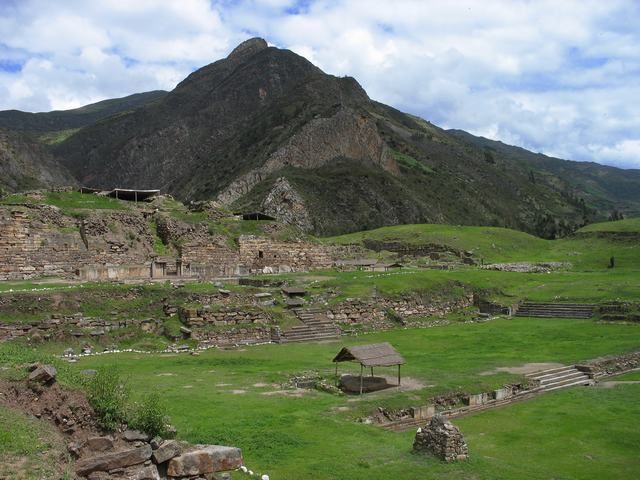
Image Courtesy of Wikipedia (CC BY-SA three.0). Chavín de Huántar
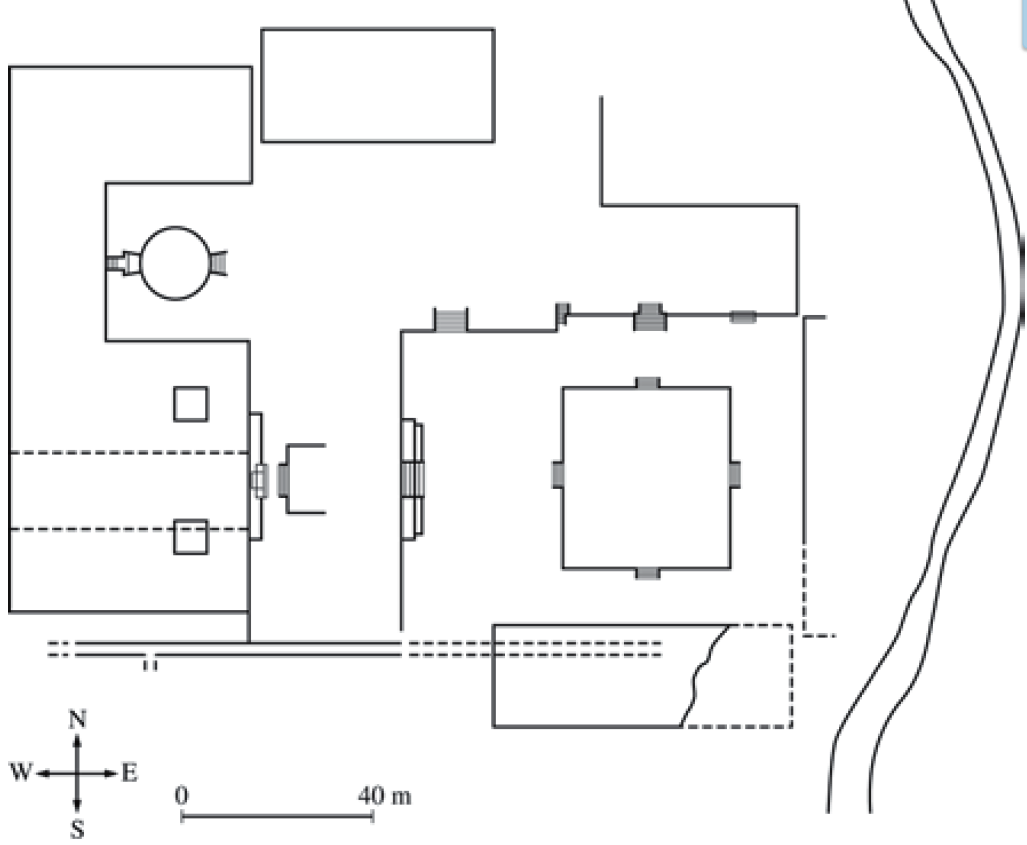
Image Courtesy of Pinterest. Plan of Chavín de Huántar
Sculpture
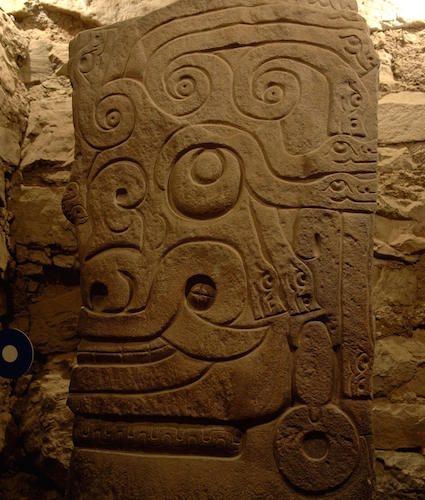
The majority of Chavín sculptures combined both human and animal forms or were zoomorphic (animal-like 🐍) in appearance but worn by humans, as y'all tin can see in the works below. This is similar to many works from unit i, where artists combined both beast and human motifs (features or designs) to emphasize their relationship with i another and importance in each other'southward lives ( ⬅️ adept example of a cantankerous-unit of measurement and cantankerous-geographical connection). Nearly sculptures from Chavín also have left-right symmetry.
Resource:
Epitome Courtesy of Khan Academy. Lanzón Stone (one side of the carving)
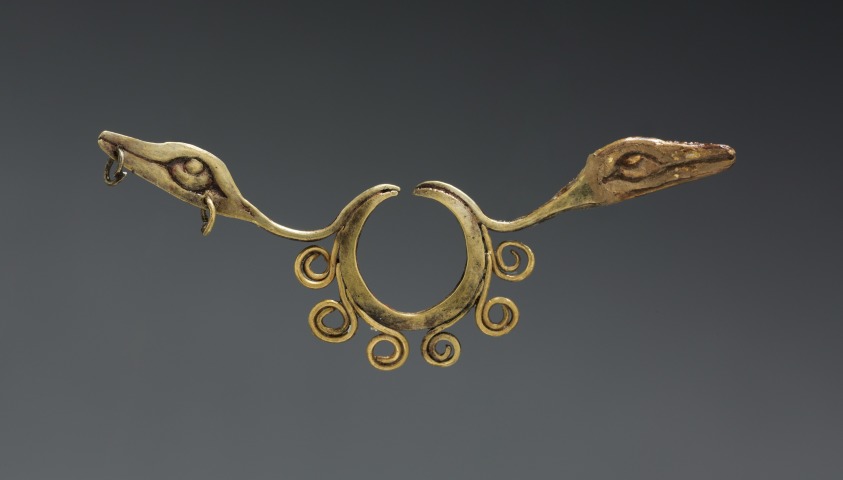
Image Courtesy of the Cleveland Museum of Fine art. Nose decoration
Describe the relationship between animals and humans in both of these works. (Don't look annihilation upwards; simply use your art historian skills to find visual clues.)
Mayan 🇲🇽 🇧🇿 🇭🇳 🇸🇻 🇬🇹
Compages
The Mayans were well-known for constructing pyramids and temples, which were ordinarily built near one another in plazas like the one nosotros saw in Chavín or on top of one another. These buildings were congenital using the corbelled vaulting technique, which means that curvation-like structures were placed in a space like an entryway to support the roof. They were especially of import in the construction of Mayan buildings considering many of them accept roof combs (a structure placed on top of a temple-pyramid), which gave them both added height 📏 and weight 🏋️ Although they made the construction procedure more hard 🤯, roof combs were important to Mayan architects considering they accentuated the verticality of their buildings.
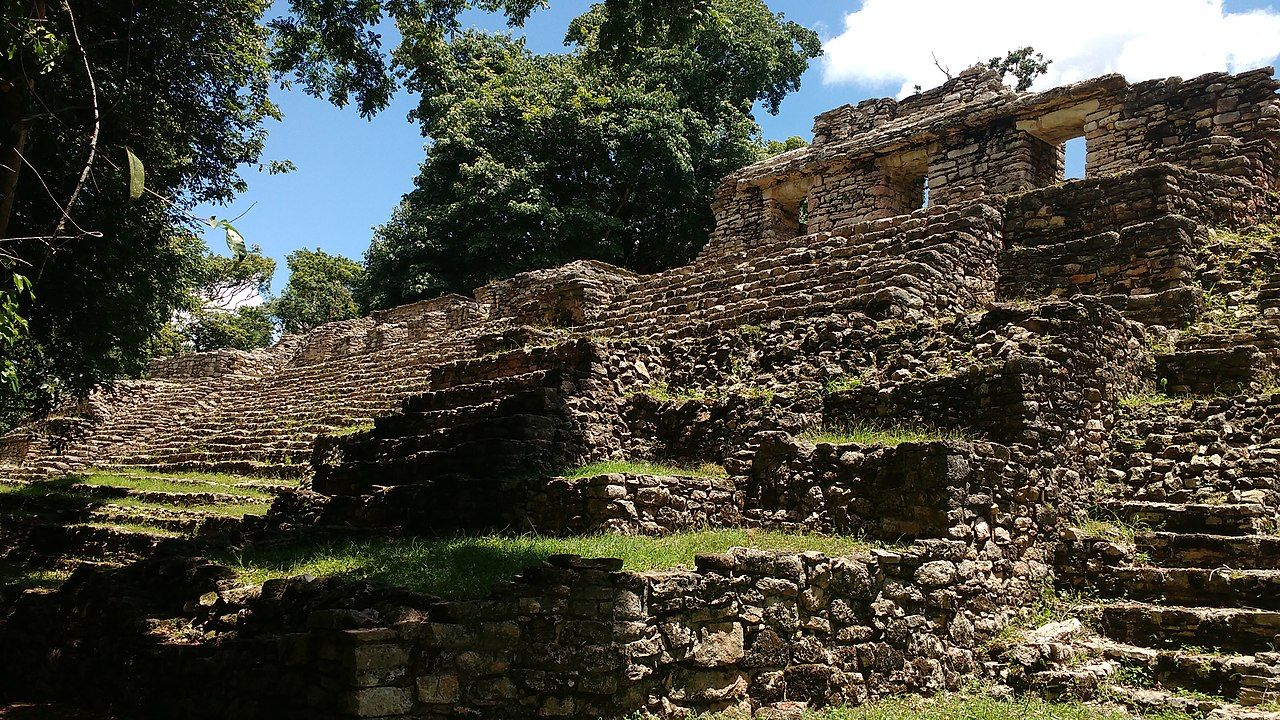
Image Courtesy of Wikipedia (CC BY-SA 4.0). Structure 33 at Yaxchilán
Sculpture
Many Mayan sculptures picture humans, which are depicted with protruding brow basic, total lips 👄, and crossed eyes 👀 ( ⬅️ this completely contradicts European standards of beauty from previous units). The majority of these humans are well-respected figures (gods and goddesses, historical people, etc.) and are pictured in unlike events to tell a story 📖 to the piece of work'southward viewer (narrative art). As you can see beneath, the Mayans were particularly addicted of relief sculpture (sculpture that is yet attached to its media, rather than carved abroad) and used the technique most exclusively when making sculptures.
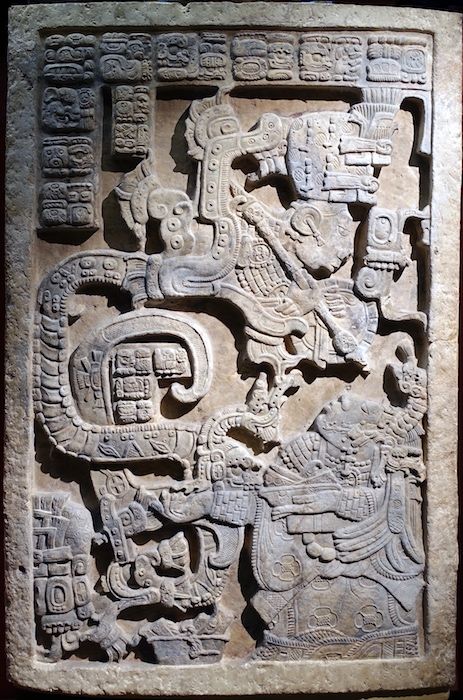
Paradigm Courtesy of Khan Academy. Lintel 25, Structure 23
How do the beauty standards pictured in Lintel 25, Structure 23 contradict with those we've seen in units 2-4 (ex. Greece, Renaissance Italy, Roman verism, etc)?
Anasazi 🇺🇸
The Anasazi were know for their pueblos (adobe homes that are stacked onto one another), of which the Mesa Verde cliff dwellings are the well-nigh well-known example. As their name suggests, these pueblos were built into the side of a cliff, similarly to Petra and the Bamiyan Buddhas in u[nit 7](Link to published Unit seven guide). In front of the homes 🏠 is a plaza, where their inhabitants would gathe, and, maybe, complete daily tasks together and accept religious ceremonies. Because they were built beneath cliffs, the residents of the Mesa Verde cliff dwellings had to farm 🌽 and get together h2o🚰 on the plateau higher up and bring it downward to their customs (that's kind of inconvenient 😉 ).
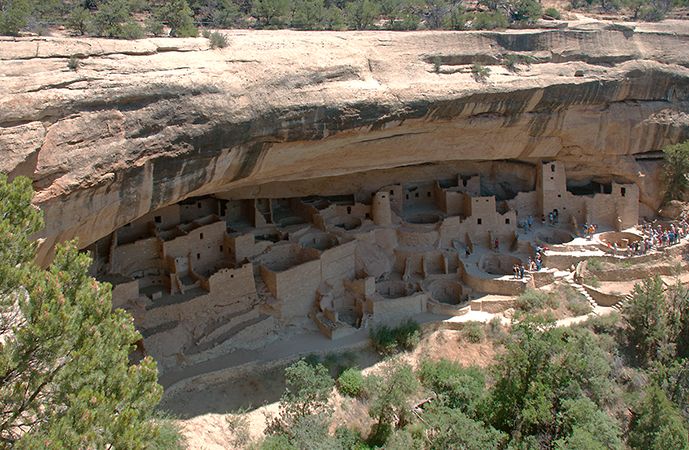
Image Courtesy of Khan Academy. Mesa Verde Cliff Dwellings
Mississippian 🇺🇸
Different its proper name suggests, the Mississippian culture didn't originate in the country of Mississippi, but instead, a big section of the midwest, southern, and eastern United States near the Mississippi River. The people of the easternmost part were Mound-Builders (people who built mounds for various reasons, including religion and ceremonies) and sometimes made them into shapes. At that place are many theories as to what is pictured in the mound below, but the most popular theories are that it is a ophidian of some sort (most likely a rattlesnake) 🐍, or a representation of Halley's Comet ☄️
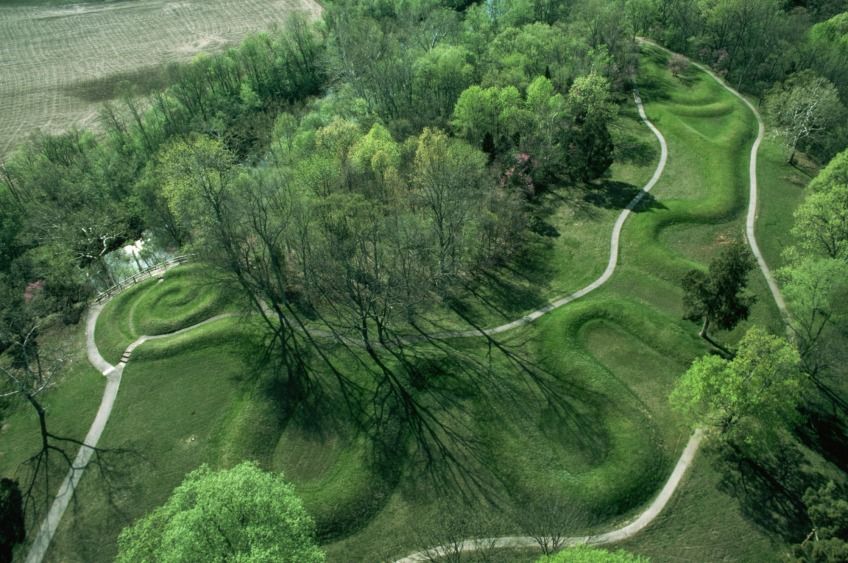
Image Courtesy of the National Library of Medici. Cracking Serpent Mound
Aztec 🇲🇽
The single greatest influence on Aztec artwork, both sculpture and architecture, its polytheistic (more than 1 god or goddess) religion. Aztec religion has a reputation for beingness aggressive and fierce 😡, which is why nigh of the works from this civilization have to exercise with ceremonies such as claret-letting and routine human sacrifices. Most sculptures depict a mythological story that has to do with the previously mentioned topics, and were used in those rituals. For example, the Coyolxauhqui Stone (pictured below ⬇️) depicts a human sacrifice and was placed at the bottom of a pyramid where these sacrifices were done.
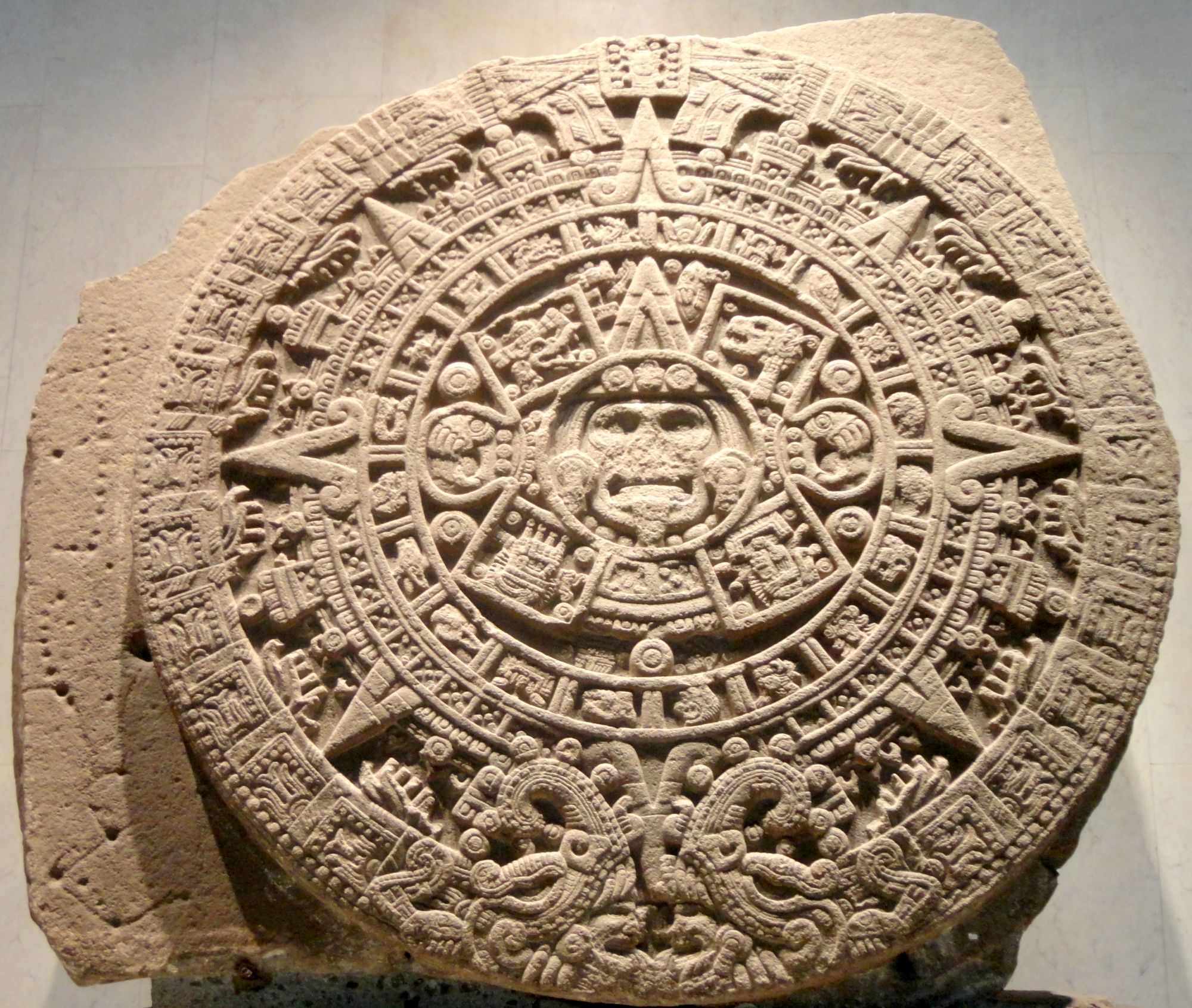
Image Courtesy of Wikipedia (CC BY-SA 4.0). The Calendar Rock
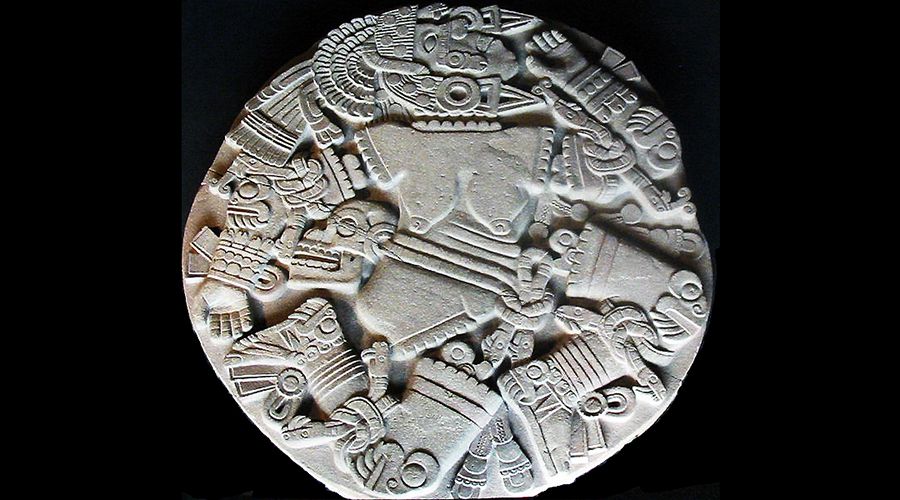
Image Courtesy of Wikipedia. The Coyolxauhqui Stone
Incan 🇵🇪 🇪🇨 🇧🇴 🇦🇷 🇨🇱 🇨🇴
The Inca congenital their capital metropolis, Cusco, using the ashlar masonry technique (similarly-shaped stones continued together with mortar), which shows their architectural 🏢 skill. Ordinarily, the edges of the rocks are slightly curved and do not 🚫 form a straight line, emphasizing the trapezoidal shape of Incan buildings. Although many of these cultures are singled-out, a mutual theme throughout all indigenous American architecture is pyramid and trapezoid-shaped buildings. Information technology isn't known whether the Inca did this for aesthetic or religious purposes like the Aztec and Maya did.
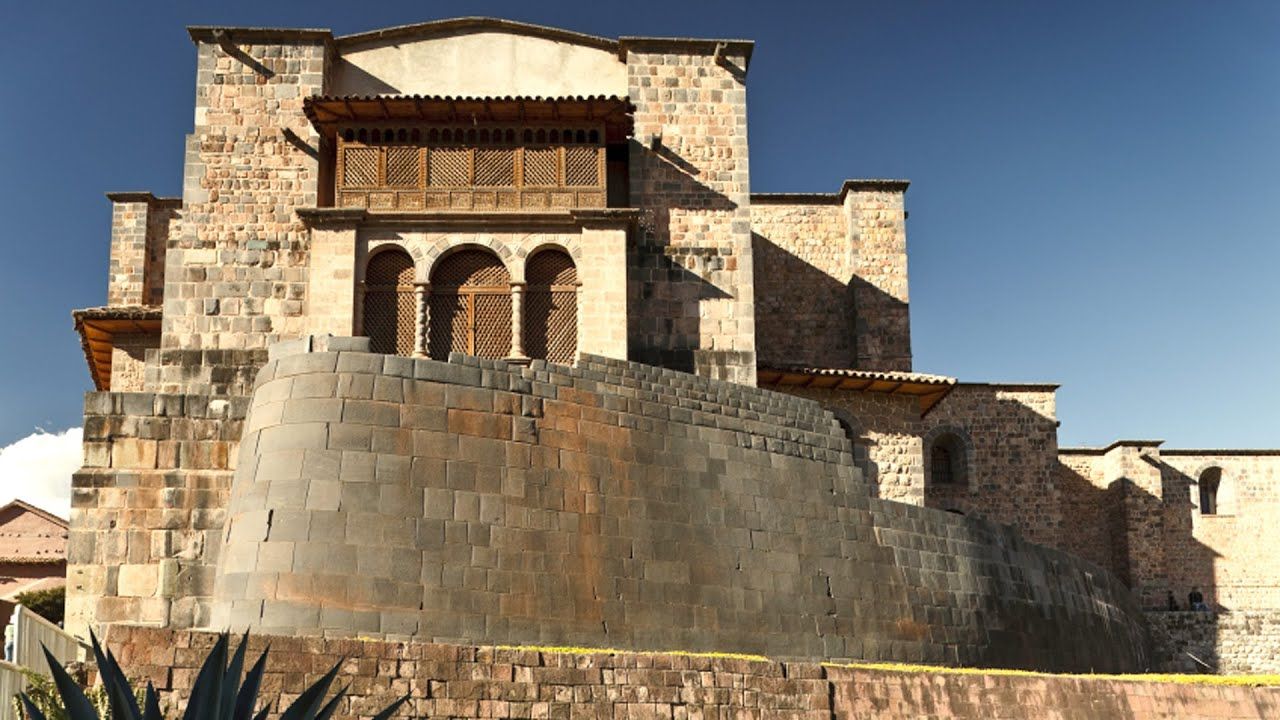
Epitome Courtesy of Viator Travel on Youtube.
Native Northward America 🇺🇸 🇨🇦
The media (materials) used and appearance of Native N American art varies profoundly by region, which include the Arctic ❄️, Pacific Northwest 🌲, Southwest 🏜️, Plains 🌾, and Eastern Woodlands 🌳. When European explorers came to these regions and introduced them to their artistic traditions, Native American artists began to use new European mediums such as beads and brighter pigments 🎨 in their previously traditional artworks. Eventually, European settlers and tourists to reservations gained interest in Native American art and became the main marketplace for selling these works, similar the Black-on-Black Ceramic Vessel pictured below.

Image Courtesy of Khan Academy. Transformation Mask
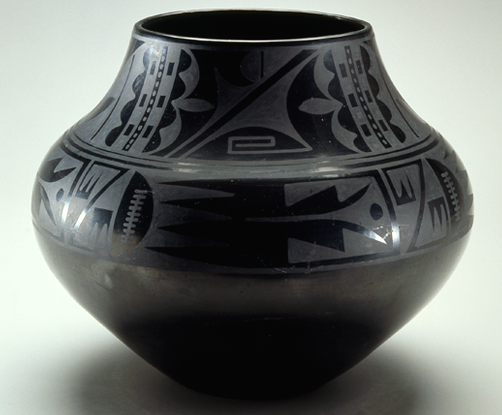
Image Courtesy of Khan Academy. Black-on-Black Ceramic Vessel
And that'south it for unit 5! Hopefully, this review helped you prepare for your class and the AP Art History exam. Happy studying, art historians 🎨!
Summary of the works
| Art | Location | Form | Date |
| Chavín de Huántar | Chavín de Huántar District, Republic of peru | Granite | 900-200 BCE |
| Yaxchilán Lintel 25, Structure 23 | Chiapas, Mexico | Limestone | 725 CE |
| Mesa Verde Cliff Dwellings | Montezuma County, Colorado | Sandstone | 450-1300 CE |
| Great Serpent Mound | Adams County, Ohio | Earthwork | c. 1070 CE |
| Templo Mayor | Mexico Urban center, United mexican states | Stone | 1375-1520 |
| Ruler'south Feather Headdress | Mexico | Feathers and gold | 1428-1520 |
| Maize Cobs | Cusco, Peru | Sheet metallic and gold and silvery alloys | c. 1400-1533 |
| City of Cusco | Cusco, Peru | Sandstone | c. 1440 |
| Machu Picchu | Cusco Region, Peru | Granite | 1450-1540 |
| All-T'oqapu Tunic | Republic of peru | Camelid fiber and cotton wool | 1450-1540 |
| Bandolier Bag | Oklahoma, USA | Beads and leather | c. 1850 |
| Transformation Mask | Alarm Bay, Canada | Pigment, wood, and string | late 19th century |
| Painted Elk Hide (Hibernate Painting of a Sun Dance) | Wind River Reservation, Wyoming | Elk hide and paint | c. 1890-1900 |
| Blackness-on-Blackness Ceramic Vessel | San Ildefonso Pueblo, New Mexico | Ceramic | mid 20th century |
Source: https://library.fiveable.me/ap-art-history/unit-5/ap-art-history-unit-52-turtle-island-regions/study-guide/5sVEHpRPCE5KSt3QuD8W
0 Response to "Chavin De Huantar 900200 Bce Ap Arts Yaxchilan 725 Ce Ap Arts"
Post a Comment